
Emergency readiness for families: ambulance, oxygen and blood bank basics
In an emergency there is no time to search. A little preparation, the right numbers, a simple plan and a ready bag, can save precious minutes. A practical guide for Indian families.
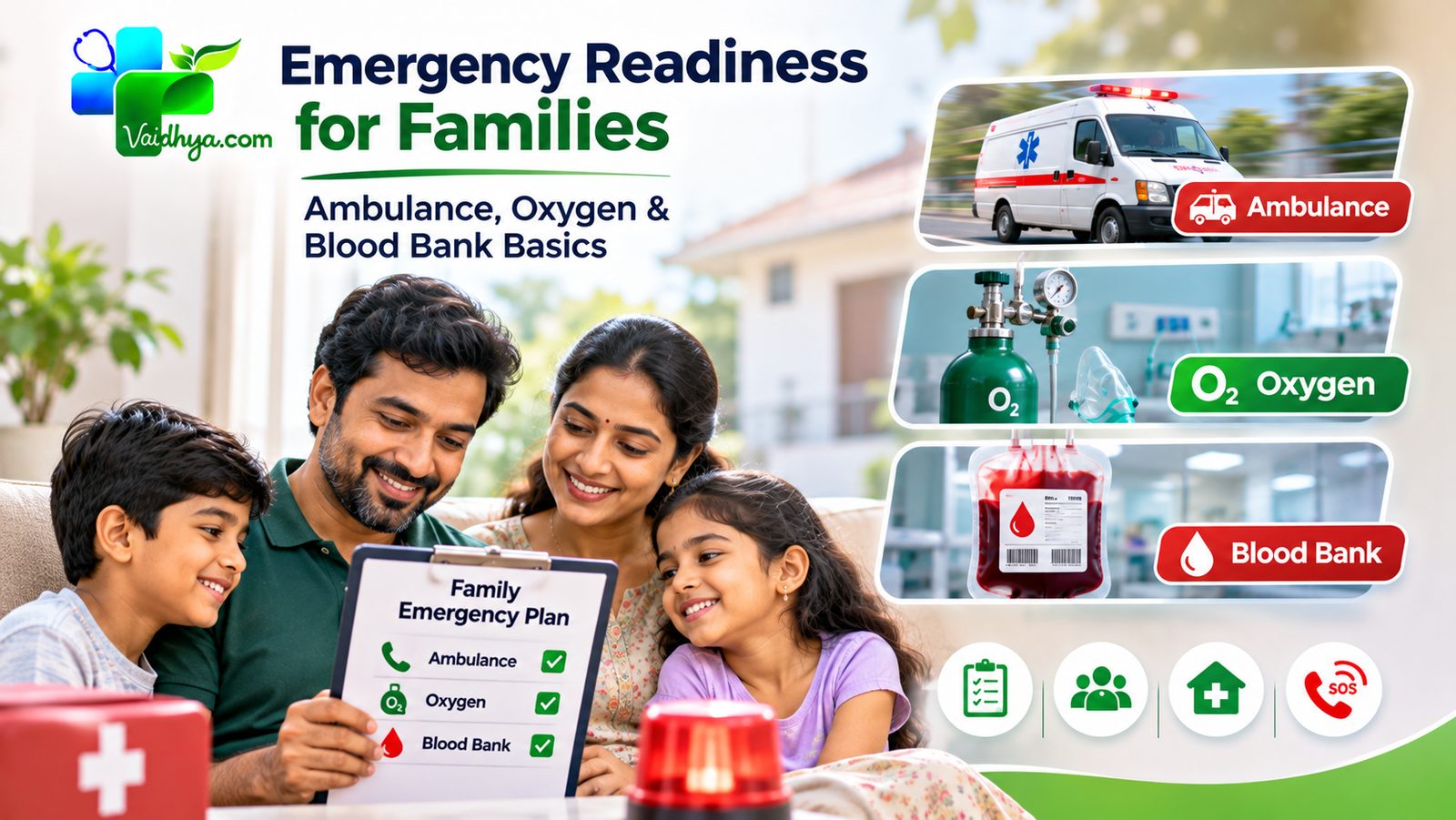
The best time to prepare for a medical emergency is before it happens. When someone you love collapses or struggles to breathe, minutes matter, and panic makes it hard to think. Knowing what counts as an emergency, whom to call, where the nearest hospital is, and what to carry can save precious time and reduce fear.
This guide is for families, and especially for those caring for older relatives, young children, pregnant women or people with long-term illnesses. It covers how to recognise an emergency, how to call and use an ambulance, what to know about oxygen at home, how blood banks work, what to put in a go-bag, and how to make a simple family plan. It is general information, not medical advice or a substitute for first-aid training. If you think someone is in danger, call for emergency help immediately.
On Vaidhya, ambulance services, oxygen and blood banks are listed alongside hospitals, so that the help you need is in one place. The advice below applies whichever service you use.
What counts as an emergency
Not every illness is an emergency, but some situations always are. Go to the nearest hospital or call an ambulance without delay if you see any of the following.
- Chest pain or pressure, especially with sweating, nausea, breathlessness or pain spreading to the arm, jaw or back.
- Difficulty breathing, or breathlessness at rest, blue lips, or severe wheezing.
- Signs of a stroke: sudden weakness or numbness on one side, a drooping face, slurred speech, confusion, sudden severe headache or loss of balance.
- Loss of consciousness or unresponsiveness, or a seizure that does not stop.
- Severe bleeding that does not stop with pressure.
- Serious injury, such as a road accident, a head injury, a deep wound, a suspected broken bone or a severe burn.
- Poisoning or a suspected overdose.
- Severe allergic reaction with swelling of the face or throat, or difficulty breathing.
- A high fever in a very young baby, or any fever with stiff neck, rash or drowsiness.
- Pregnancy emergencies: heavy bleeding, severe abdominal pain, reduced baby movements, or labour with complications.
- Severe or sudden abdominal pain, especially with vomiting or a hard, swollen belly.
- Thoughts of self-harm. Seek help immediately from emergency services or a trusted person.
If you are unsure whether something is an emergency, treat it as one and seek help. It is better to be told it was minor than to wait too long. This list is not complete. For less urgent problems, our guide to choosing the right kind of care explains where to start.
Know your numbers, and save them where everyone can find them
In India, there is a single national emergency number, and several state and service numbers for ambulances and other help. Numbers and services can change, so check which ones work in your city, and save them.
Write down and share with the whole family:
- The national emergency number and your state ambulance number, where available
- The nearest hospital with an emergency department, with its address and phone number
- A second hospital in case the first is full or far
- The family doctor's number
- A private ambulance service you trust
- Contacts for relatives and neighbours who can help quickly
Put the list on the refrigerator, in each phone's favourites, and in the go-bag. Children and older relatives should know where it is and how to use it. An emergency list that only one person knows about is not much use if that person is the one who has collapsed.
Calling an ambulance: what to say and what to do
When you call, stay calm and speak clearly. The person on the line will ask for a few things. Be ready with:
- Your exact location, with a landmark, and how to reach it. Say the building, floor and any gate or lane that is hard to find.
- What has happened, in a sentence: "My father collapsed and is not responding", "She is having chest pain and sweating".
- How many people are affected, the age and sex of the patient.
- Whether the person is conscious and breathing.
- A phone number they can reach you on, and keep it free.
Then:
- Follow the instructions you are given. Some operators guide you through first aid while the ambulance comes.
- Unlock gates and doors, switch on lights, and send someone to the road to wave the ambulance in.
- Gather the patient's medicines, previous reports and ID, and a phone charger if you can do so quickly.
- Do not give food or drink to someone who may need surgery or who is not fully conscious, unless advised.
- Do not move someone with a suspected spine or head injury unless they are in immediate danger.
Ask which hospital the ambulance will go to, and whether it is the right one for the problem. For heart attacks, strokes, major trauma and serious pregnancy emergencies, it matters that the hospital has the facilities. Where possible, the choice of hospital should be made with medical advice.
Types of ambulances
Not all ambulances are equipped in the same way. Knowing the difference helps you ask for the right one.
| Type | What it usually offers | When it is used |
|---|---|---|
| Basic transport | A vehicle to carry a patient, with a stretcher and basic first aid | Non-critical transfers, such as to or from a hospital |
| Basic life support | Trained staff and equipment for oxygen, basic monitoring and stabilisation | Most emergency calls |
| Advanced life support | Equipment and staff to manage critical patients, such as a monitor, defibrillator, ventilator support and injections | Heart attacks, serious breathing problems, major trauma |
| Patient transport for special needs | Vehicles for bedridden patients, with a stretcher or special seating | Dialysis visits, appointments and discharges |
If the patient is very sick, ask for a vehicle with oxygen and trained staff. If it is a planned transfer, book in advance and confirm the vehicle type, the price and the driver's contact. Keep in mind that pricing differs, and ask before you book. On Vaidhya, ambulance services are listed so you can find one near you and contact it quickly.
Oxygen at home: what families should know
Some people need supplemental oxygen at home, for example because of a lung condition, after a serious illness, or on the advice of a doctor. Oxygen is a medicine. It should be used only on a doctor's advice, in the amount prescribed.
Ways to have oxygen at home
- Oxygen cylinders: store compressed oxygen and run out, so they need refilling.
- Oxygen concentrators: machines that draw oxygen from the air and run on electricity. They are widely used for continuous home therapy.
- Portable concentrators: smaller devices for use when going out.
Safety
- Oxygen makes fires burn faster. Keep it away from flames, candles, lamps, cooking, cigarettes and sparks. Nobody should smoke near it.
- Secure cylinders upright so they cannot fall.
- Keep a backup, such as a spare cylinder, and a plan for power cuts if you use a concentrator.
- Learn how the equipment works, and how to check the flow.
- Use only on a doctor's instruction, and do not change the flow without advice.
- Know the warning signs that mean the patient should go to hospital, and have those written down.
If you need oxygen urgently, ask your doctor, a hospital or a listed oxygen service. Check supply and pricing in advance, because demand can rise sharply in some seasons. If a relative is recovering at home, home nursing care can help with monitoring and equipment.
Blood banks: how they work and how to plan
Blood is needed for surgery, accidents, childbirth complications, cancer treatment and conditions such as anaemia and thalassaemia. Blood banks collect, test, store and issue blood and its components, such as red cells, plasma and platelets.
What families should know
- Know your blood group, and that of close family members. Write it down.
- Hospitals often have their own blood banks, and some ask families to arrange replacement donors. Ask early when a surgery is planned.
- Blood must match. Hospitals test compatibility before transfusion.
- Blood has a shelf life, and certain components, especially platelets, last only a short time. In emergencies, supply depends on what is available.
- Use licensed blood banks. Avoid unofficial sellers. Safe blood is screened and handled under regulation.
Donating
Healthy adults can usually donate blood regularly, subject to health checks and the rules on eligibility. If you are able, donating through a licensed blood bank or a camp is one of the most valuable things you can do. It helps strangers, and when your own family needs blood, community donors are what keep the supply going.
On Vaidhya, blood banks are listed with the hospitals and other emergency services, so you can find one near you. In a real emergency, always confirm availability by phone, and ask the hospital which blood bank it recommends.
Pack a go-bag
If someone in the family has a long-term condition, is pregnant, or is elderly, a ready bag saves time and stress. Keep it in a known place, and refresh it every few months.
- A folder with ID, insurance papers and recent prescriptions and reports, plus copies on your phone
- A list of regular medicines with doses, allergies and conditions
- A few days of essential medicines, in labelled boxes
- Cash and cards, because digital payments can fail
- A phone charger and power bank
- Basic supplies: sanitiser, masks, a small first-aid kit, a thermometer
- A change of clothes, toiletries and a light blanket for the patient and the carer
- Emergency contacts on paper
- For a pregnant woman: the maternity file and baby essentials
Keep a digital copy of key documents in a cloud folder or a health records app, so that they are available if the paper copies are lost. On Vaidhya, you can keep health records and medicine reminders for the whole family in one place.
Make a simple family plan
A short conversation, once, can make an emergency far less chaotic. Sit down with the family and agree on:
- Who calls whom. A named person for the ambulance call, and another to inform the family.
- Which hospital you will go to first, and the second choice.
- Where the go-bag, the documents and the medicine list are kept.
- Who stays with the children or the older relative at home.
- How to reach each other, and where to meet if you cannot.
- What each person can do, such as first aid, driving, or arranging blood donors.
Practise the plan once, including how to find the nearest hospital on a map and how to describe your address. Children old enough to use a phone should know how to call for help and what to say.
Learn basic first aid
Simple first-aid skills can keep someone alive until help arrives. Consider taking a short certified course. It teaches skills that are hard to learn from reading, such as how to do CPR properly, how to help someone who is choking, how to control bleeding, and how to position an unconscious person safely.
Many hospitals, the Red Cross and other organisations offer courses for families, workplaces and schools. Refresh your skills every year or two, because confidence fades. If you cannot attend a course, ask your family doctor for guidance and look for reliable, recent resources. Please do not rely on forwarded messages for first-aid advice, because some are wrong or outdated.
Using technology without depending on it
Phones can help in an emergency. They share your location, let you call and message, and give access to maps and records. They can also fail, run out of charge, or have no signal. So use them as a supplement.
- Save emergency contacts in favourites and, where your phone allows, in an emergency-contact feature on the lock screen.
- Keep a phone charged, and a power bank in the go-bag.
- Install the apps you need and sign in before an emergency. Searching for a password at the wrong moment is a common problem. On Vaidhya, you can find hospitals, ambulances, oxygen and blood banks, and keep your records, from the app.
- Keep paper copies of the most important information.
- Tell family members where to find things, so that anyone can help.
If you are comparing apps for this, why Vaidhya explains what is in one place, and Vaidhya vs Apollo 24|7 looks at one hospital-group alternative. Finally, remember that apps are tools for finding and organising help. In a true emergency, the first step is always to call emergency services or get the patient to a hospital as quickly and safely as you can.
Frequently asked questions
What should I do first in a medical emergency?
Call your emergency number or get the patient to the nearest hospital emergency department. Give your exact location and describe what has happened. Follow the operator's instructions while you wait.
Do I need a prescription for oxygen at home?
Oxygen is a medicine and should be used only on a doctor's advice, in the amount prescribed. Do not start or change oxygen without medical guidance, unless it is a genuine emergency and you are following emergency instructions.
How do I find a blood bank near me?
Ask the hospital where care is happening, or use a directory of licensed blood banks. On Vaidhya, blood banks are listed with other emergency services. Always confirm availability by phone.
What should be in a family emergency bag?
ID and insurance papers, prescriptions and reports, a list of medicines and allergies, a few days of essential medicines, cash, a charger and power bank, basic first-aid supplies and a change of clothes.
Can I book an ambulance on Vaidhya?
Ambulance services are listed on Vaidhya under emergency services so you can find and contact one near you. In a life-threatening emergency, call your emergency number first.
Keep help one tap away
Find ambulances, oxygen, blood banks and hospitals, and keep your family's records in one place.
Download the appKeep reading

Practo alternatives: how to choose a doctor-booking platform in India
Patients, doctors and hospitals can choose from several healthcare apps. Here is an honest framework to compare them, what each type is good at, and where Vaidhya fits.
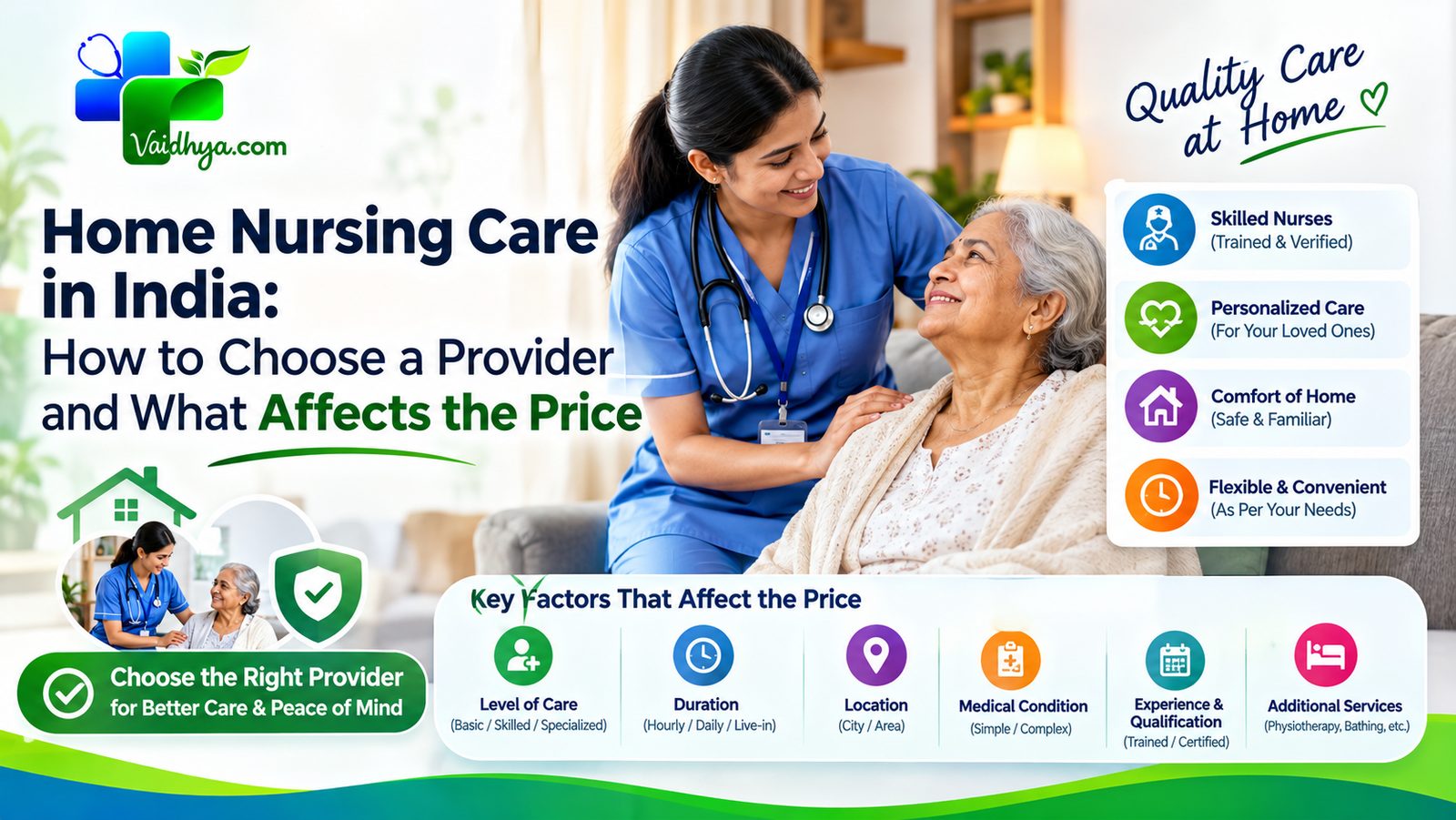
Home nursing care in India: how to choose a provider and what affects the price
Home nursing, physiotherapy and attendant care can make recovery easier for the whole family. Here is how to choose a safe provider, what to ask, and why prices differ.
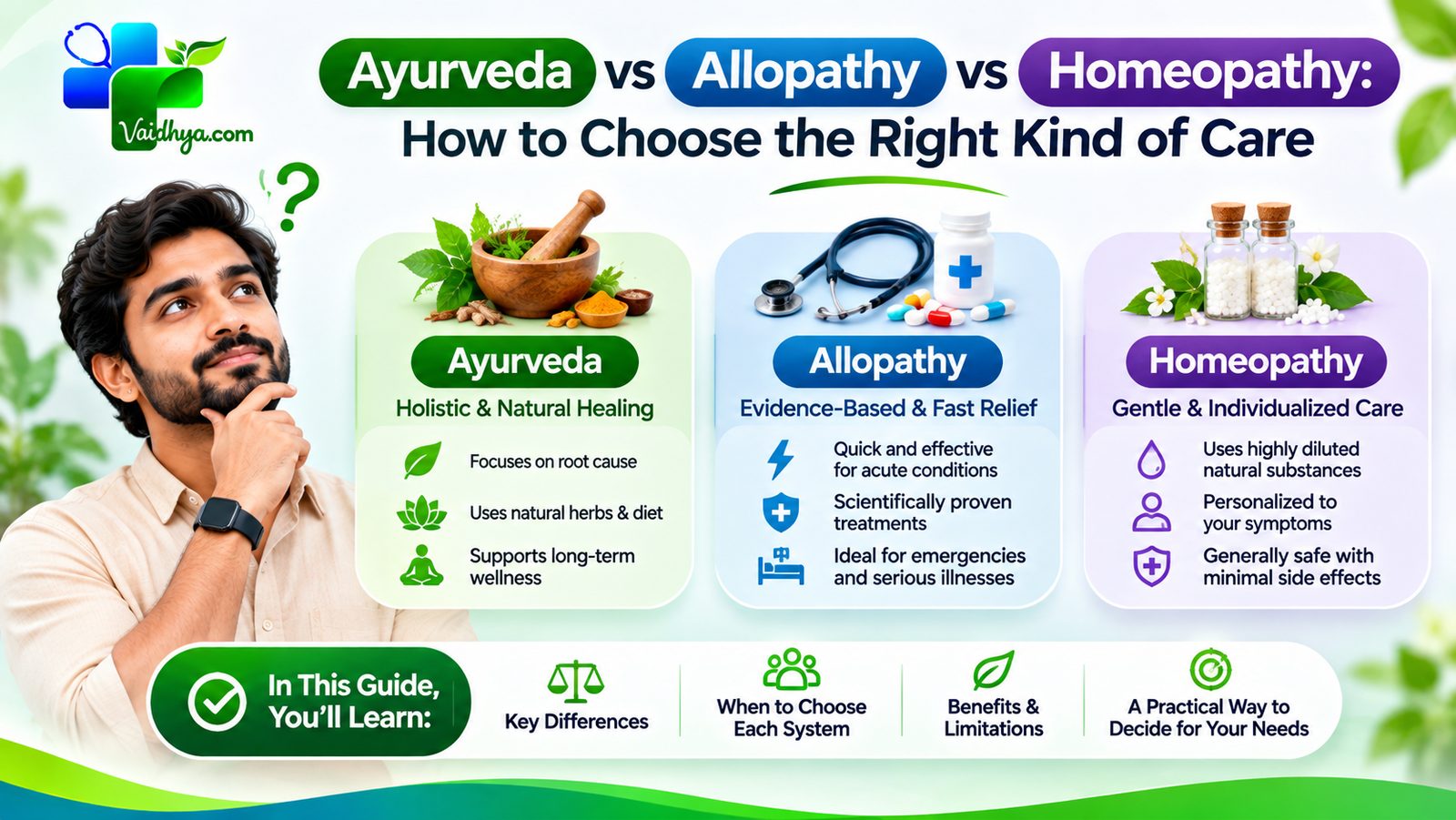
Ayurveda vs Allopathy vs Homeopathy: how to choose the right kind of care
India has many systems of medicine, and many families use more than one. A clear, non-partisan guide to what each is, when to start where, and how to stay safe.
Ready to join Vaidhya?
Download the app and be part of the platform bringing Indian healthcare together.