
How to reduce patient no-shows and waiting time in your clinic: 12 practical steps
Empty slots and crowded waiting rooms cost clinics money and goodwill. These twelve practical steps cut no-shows and waiting without adding staff.
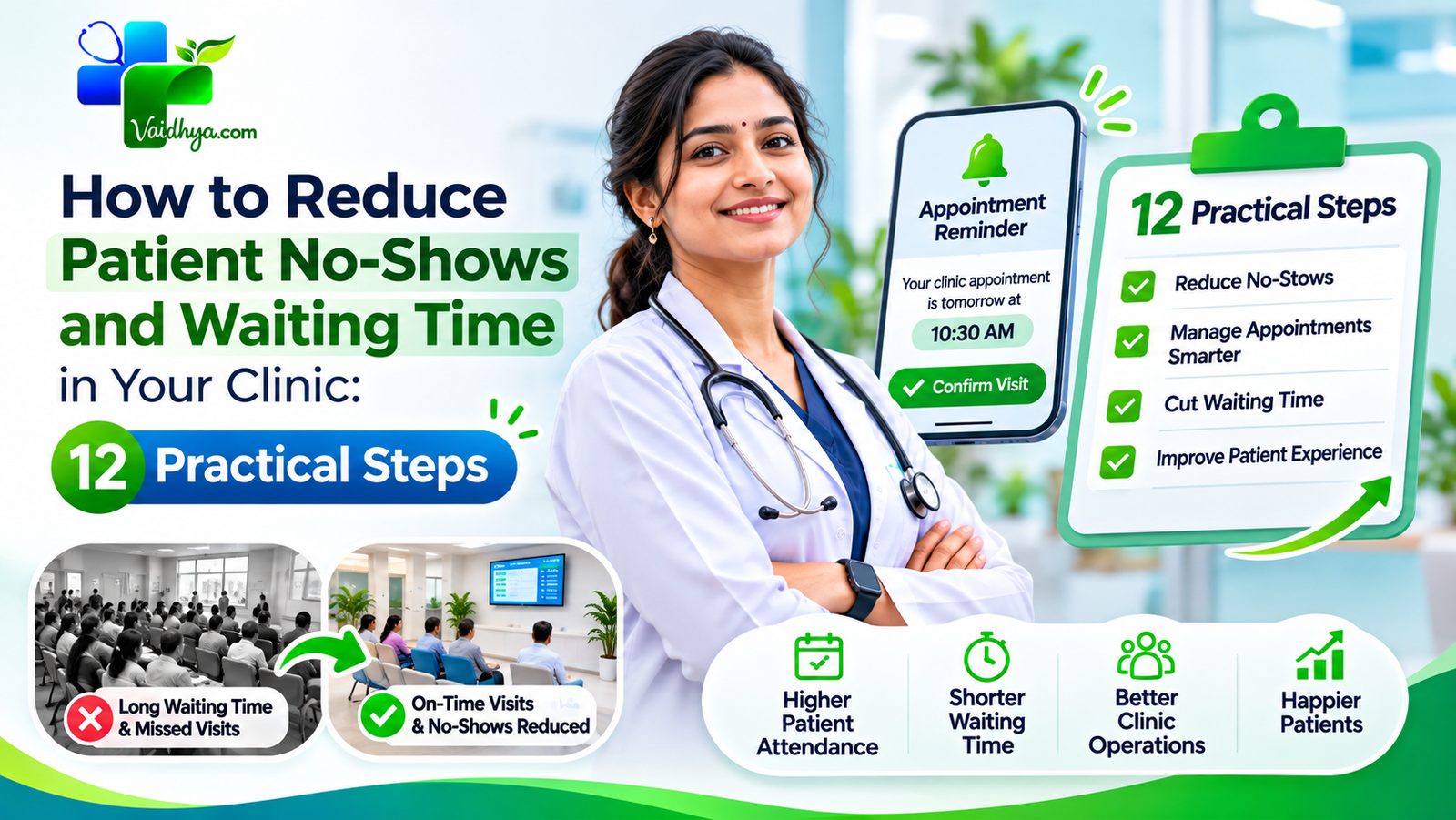
Clinics reduce no-shows and waiting time by making appointments easy to keep, easy to change, and honest about timing. Reminders, realistic schedules, a visible queue and a simple cancellation route address most of the problem. None of them needs extra staff.
No-shows and waiting are two sides of the same coin. When patients do not arrive, doctors sit idle and slots are wasted. When too many arrive at once, the waiting room is crowded, and patients who waited a long time are less likely to come back. A clinic that manages both builds a calmer day and a better reputation.
This article gives twelve practical steps. They suit a single-doctor clinic and a multi-speciality centre. If you are listing your clinic on a platform such as Vaidhya for clinics, several of these steps are built in, but the principles hold wherever you work.
Understand why patients do not turn up
Before fixing the problem, it helps to know its causes. Patients miss appointments for reasons that are usually ordinary:
- They forgot, especially if the booking was made days or weeks earlier.
- Something changed: work, travel, a family event, or they felt better.
- They could not cancel easily, so they simply did not come.
- They feared the wait and decided it was not worth the trip.
- The appointment was too far in the future and the need passed.
- They found a closer or faster option.
Notice that most of these are fixable with design, not with blame. A system that is easy to use and respects the patient's time will see fewer no-shows than one that tries to punish them.
Start by counting. For two weeks, record how many booked patients did not come, which days and times were worst, and how far in advance they had booked. This gives you a baseline and shows where to focus.
Step 1 to 3: make booking and keeping appointments easy
1. Let patients book online, any time
Patients who book at the moment they decide are more likely to keep the appointment than patients who must call during clinic hours. Online booking also frees your front desk from repetitive calls.
2. Show real availability only
If your slots are shown as available but you are already full or the doctor is away, patients will be disappointed and may not come back. Keep your timings accurate and close sessions when you are on leave.
3. Keep the booking window sensible
The further ahead a booking is made, the more likely it is to be missed. For routine consultations, a window of a few days to a couple of weeks works well. For follow-ups of chronic conditions, longer is fine if you send reminders.
Step 4 to 6: remind, confirm and make cancelling painless
4. Send reminders
A reminder the day before, and again a few hours ahead, is the single most effective way to reduce no-shows. Keep it short: the doctor's name, the date and time, the place, and how to cancel.
5. Ask for a quick confirmation on high-demand slots
For specialists whose slots are scarce, ask patients to confirm their visit. Slots that are not confirmed can be released to people waiting.
6. Make cancelling and rescheduling one tap
If cancelling is hard, patients will not do it. A clear cancel and reschedule option lets the slot be reused. On Vaidhya, patients can see and manage their upcoming and past appointments in one place.
A cancelled slot you know about is a slot you can fill. A no-show is only a loss.
Step 7 to 9: schedule realistically
7. Match slot length to the real visit
If your average consultation takes twelve minutes and your slots are ten, delays pile up through the morning. Track the real average for each type of visit and set slots to match, with a small buffer.
8. Separate new patients, follow-ups and procedures
These take different amounts of time. Giving them different slot lengths, or different sessions, keeps the day predictable.
9. Plan for walk-ins and emergencies
Reserve a small share of each session for patients who arrive without a booking and for urgent cases. Without this buffer, every unexpected patient delays everyone else.
If you run a hospital OPD rather than a small clinic, the same ideas scale up with tokens and a live queue. See our complete guide to OPD token systems.
Step 10 to 12: make waiting visible and bearable
10. Show the queue
Waiting is far more tolerable when patients know how long it will be. A visible queue, on a screen or on the patient's phone, turns an anxious wait into an informed one. Patients can step outside or run an errand and come back when their turn is close.
11. Tell people when you are running late
A short message such as "Dr Rao is running 20 minutes behind" costs nothing and is deeply appreciated. Silence is what patients resent.
12. Use waiting time well
Staff can use the wait to collect basic information, check past reports, take vitals or explain what to expect. Seats, water and a clear place for elderly patients make a long wait easier. Better still, aim to shorten it by following steps 7 to 9.
A sample daily routine for a small clinic
Here is a routine you can adapt. It uses nothing beyond a booking system and a phone.
| Time | What happens |
|---|---|
| Evening before | Reminders go out for tomorrow's bookings. Unconfirmed high-demand slots are flagged. |
| Before opening | The front desk checks the day's list, confirms the doctor's timings, and notes expected walk-ins. |
| During clinic | Each patient is checked in on arrival, called in when the doctor is ready, and marked done. No-shows are marked after a short wait. |
| If delayed | A message goes to waiting patients with a realistic estimate. |
| End of day | The team notes no-shows and the longest waits, and books follow-ups before patients leave. |
The routine takes minutes and quickly becomes habit. After a couple of weeks, review the numbers you started with and see what has moved.
Should you charge for no-shows?
Some clinics ask for a small advance or charge a cancellation fee for late cancellations. It can reduce no-shows, but it has costs. It adds friction for honest patients, it needs clear rules, and it can feel unfriendly, especially in a field built on trust.
Try the gentler steps first: reminders, easy cancelling and realistic scheduling. If no-shows remain high for specific time slots or specific kinds of visit, consider a targeted measure for those slots only, explained clearly at booking. Whatever you do, make the rule visible before the patient commits, and apply it fairly.
Special cases: children, older patients and long-term conditions
One approach does not fit everyone. A few groups deserve their own thinking.
Children
Parents often cancel when a child feels better, or come at the last minute when a fever returns. Keep a few same-day slots for sick children, and be generous with reminders about vaccination visits, which are easy to forget and important to keep.
Older patients
Many older patients do not use smartphones, or rely on a family member to manage bookings. Keep the phone line and the counter working, ask for a family contact number, and send reminders to the person who will bring them. Seating, a ramp or lift access, and a shorter wait make a bigger difference to this group than to anyone.
Long-term conditions
For diabetes, high blood pressure, thyroid problems and similar conditions, regular follow-up is the whole point of care. Book the next visit before the patient leaves, send a reminder a day or two ahead, and, where it is clinically appropriate, offer a video or audio follow-up so a busy patient does not skip the check-up altogether.
Procedures and tests
If a visit needs preparation, such as fasting, say so in the reminder. A patient who arrives unprepared effectively becomes a no-show, and the slot is lost anyway.
The human side: what your staff should say
Tools help, but the front desk makes the difference. Simple scripts keep conversations calm and consistent.
- On booking: "Your appointment is on Thursday at 11 with Dr Rao. You will get a reminder the day before. If your plans change, please cancel or reschedule from the app or call us so we can offer the slot to someone else."
- On a late arrival: "Thank you for coming. The doctor is in a consultation and you are next. It should be about ten minutes."
- On a delay: "The doctor is running about twenty minutes behind. You can wait here, or step out and we will message you when it is almost your turn."
- On a missed appointment: "We missed you today. Would you like to book another time? It is easy to do from the app."
Notice that none of these scripts is accusing. People respond to courtesy, and a patient who is treated kindly after a missed visit is likely to return.
Train every member of the team in the same language, and review once a month what worked. A short huddle at the start of the day, ten minutes, to look at the schedule and expected problems pays for itself many times over.
Common mistakes to avoid
- Over-booking to cover for no-shows. It works until everyone turns up. A small buffer is wiser than a pile-up.
- Treating every patient as unreliable. Most people keep their appointments. Build the system for them and handle exceptions separately.
- Changing too many things at once. Make one or two changes, watch the numbers for a few weeks, then change more.
- Not measuring. Without a baseline you cannot tell whether a step helped.
- Forgetting the doctor. The schedule must be one the doctor can actually keep. Include them when you set slot lengths.
- Ignoring feedback. A note on the way out, "How was the wait today?", gives you useful information for free.
How to tell whether it is working
Pick three numbers and write them down every Friday for two months: the share of booked patients who did not come, the average time between a patient's arrival and seeing the doctor, and the number of patients who left without being seen. A fourth, softer measure is the number of positive and negative comments about waiting in your reviews.
Do not expect a sudden change. Most clinics see the no-show rate drift down over four to six weeks as reminders and easier cancelling take effect, and waiting times improve as slot lengths and walk-in buffers are tuned. If a number gets worse, look at what you changed that week before changing anything else. Small, steady improvements add up to a noticeably calmer clinic.
Using a platform to do much of this for you
You can run these steps with a notebook, a spreadsheet and a lot of phone calls. Most clinics find it easier with a tool that does them automatically. A good platform should give you:
- Online booking with real availability
- A daily list and live queue for the front desk
- A simple way for patients to see, cancel and reschedule
- Your doctors, timings and fees in one place
- Verification so patients trust the listing
On Vaidhya, clinics appear in "Find Clinics" under their category and clinic sub type, take OPD bookings, and add the doctors who consult with them. The same account can also be used to hire through the healthcare job portal. For a doctor in a solo practice, how doctors can get more patients online covers profiles, fees and trust in more detail.
Frequently asked questions
What is a normal no-show rate for a clinic?
It varies by speciality, location and how appointments are made. Rather than compare with a national figure, measure your own for two weeks and aim to bring it down steadily.
Do reminders really reduce no-shows?
Yes. A reminder the day before and again on the day is widely found to be one of the most effective and cheapest measures. Make it short and include how to cancel.
How should I handle patients who arrive late?
Decide a clear, kind policy in advance, such as seeing them at the end of the session or rebooking them, and apply it consistently. Tell patients the rule when they book.
Can a small clinic offer a live queue?
Yes. A simple list of checked-in, with-doctor and done patients is enough, and a platform can show it on a phone.
How does Vaidhya help clinics?
Clinics get a verified listing by category and sub type, online OPD bookings, a daily list and queue, and a place for the doctors who consult with them. See Vaidhya for clinics.
List your clinic on Vaidhya
Get found nearby, take bookings and keep your day organised.
Join as a clinicKeep reading

Practo alternatives: how to choose a doctor-booking platform in India
Patients, doctors and hospitals can choose from several healthcare apps. Here is an honest framework to compare them, what each type is good at, and where Vaidhya fits.

Healthcare jobs in India: how to build a strong profile and get hired
Nurses, technicians, pharmacists and hospital staff: how to present your skills, find the right openings, apply well and prepare for interviews in healthcare.
OPD token system for hospitals: a complete guide to moving from queues to booked slots
Crowded OPD counters frustrate patients and exhaust staff. A booked token and a live queue change the day for both. Here is how an OPD token system works and how to introduce one.
Ready to join Vaidhya?
Download the app and be part of the platform bringing Indian healthcare together.